How to Make Stylized Backgrounds for Portraits Digital Art
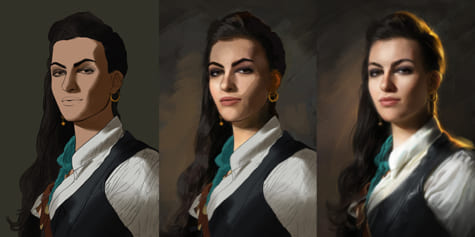
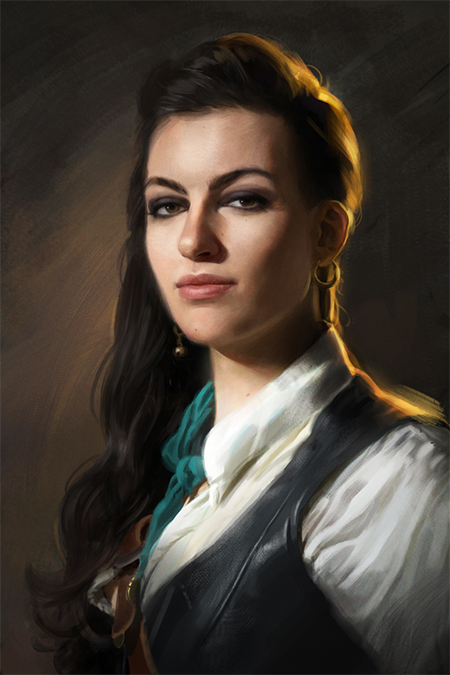
In this tutorial, German illustrator Luisa Preissler shows how she draws realistic portraits using digital cartoon programs. Using a pirate lady every bit an case, Luisa sharing tips and techniques on how to add dramatic lighting and shading to your work!
ane. Prepare up a layer construction
I e'er beginning my paintings with a make clean line art sketch. In this case, I decided to paint a portrait of a absurd pirate lady. Having precise lines helps me define each element and detail early on. It also makes the actual painting procedure a lot smoother, because I don't have to figure out the composition while painting. I put the lines on a separate layer set up to multiply, so I can begin painting under them.
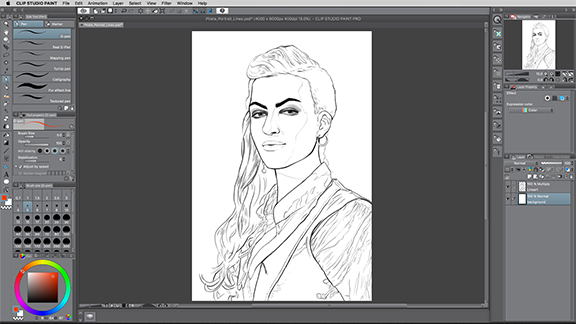
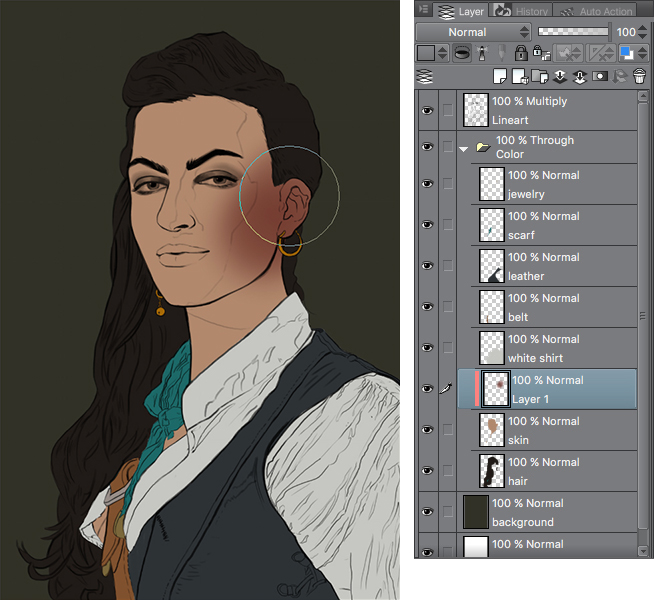
I strive to set a layer construction that makes working on the painting like shooting fish in a barrel. To this end, I similar to arrange my layers in a way so that I can paint each element of the picture separately without worrying nigh accidentally painting over the lines. My goal is to split my image into the following parts: pare, hair, background, shirt, leather, and smaller details like earrings, the chugalug, and belt buckle. And then I keep to colour them individually.
I start by manually selecting the areas with the lasso tool. You lot can use different methods like the Auto Select tool every bit well. I personally similar to have 100% command over the selection and try to avoid any jagged edges.
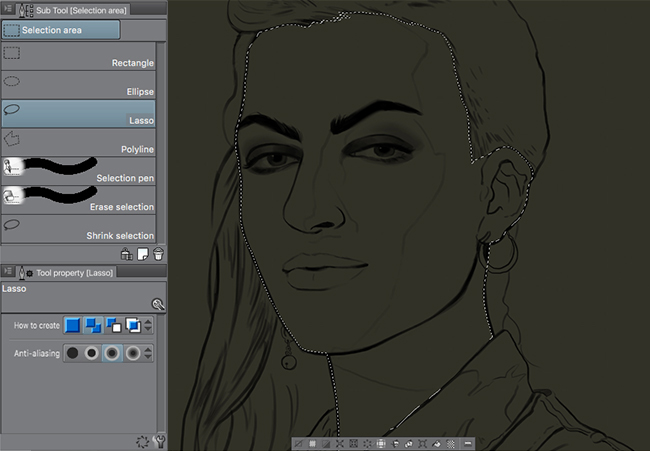
In one case the selection for the face is done, I use the Fill tool to fill in the surface area with a pare tone in the middle value range. This ways that the colors I chose here are neither too dark nor too bright so that I tin can still play with highlights and shadows afterward.

I echo this with every major element in my painting. I sometimes go equally far as to separate small things like jewelry equally well.
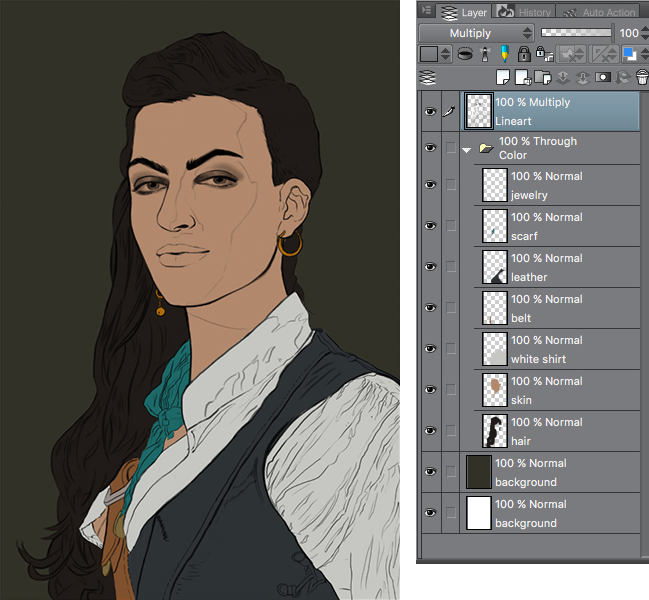
In the image above, you can run into my layer construction before I delve into painting. With every element selected and filled with a base colour, I can then either lock the transparency of each layer or utilise Clipping Masks to lay in brush strokes.
By locking the transparency, but the pre-existing pixels of a layer tin can be painted.
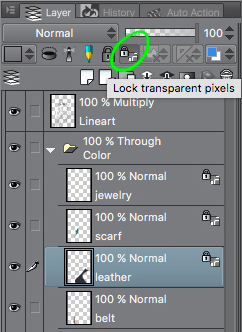
If 1 layer per motion picture chemical element isn't enough for your purpose, you can start adding clipping masks on superlative and build up layers of the picture element and painting this way.
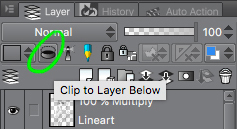
Clipping mask layers are layers that are "clipped" to the layer directly below. On clipping mask layers, you lot can only paint inside the pixels that the layer beneath already contains. I use these if I want to try things out, every bit creating a clipping mask layer makes it easy to go back. In other situations, you may want to work with different blending modes like Multiply, Overlay, or Linear Fire. You can exercise that hands on a clipping mask layer, as they only touch on a specific area.
Needless to say, this is just a technique that I frequently apply, if you similar to work directly on one layer that's totally fine, too!
2. Lighting
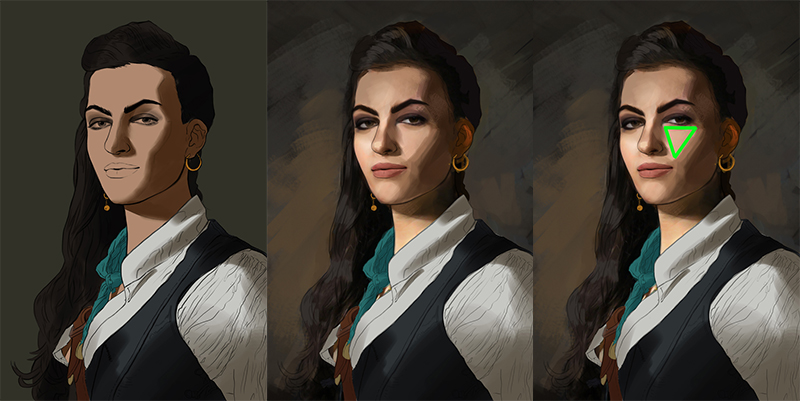
The outset matter I always call up about before painting annihilation is "Where does the light come from?" Ever make sure that your lighting is consistent: don't light one part of the picture from one side and accidentally lite other parts from some other side. I love lighting schemes with strong lights and darks that emphasize the forms. In this instance, I decided to base my lighting on a classic portrait lighting scheme called Rembrandt lighting. It's named after the famous Dutch old master painter Rembrandt and has a very distinct characteristic: a triangle of light on the cheek of the less illuminated side of the confront. Information technology'south very pleasing to the eye and makes the shadow and lite shapes interesting.
Another important factor when it comes to lighting is to differentiate betwixt form shadows and cast shadows. Class shadows are shadows that occur when the form of the object changes and one side goes into shadow. A cast shadow is when a shadow is literally cast from another object, for case, the olfactory organ. Cast shadows are often sharp, whereas grade shadows are smooth as they wrap around the form.
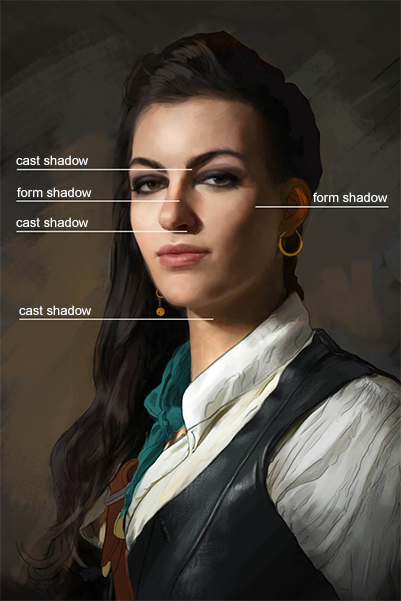
If you're unsure of where to place a certain type of shadow, information technology's very helpful to simulate the lighting on your own face and expect in the mirror or take a picture. Usually, the facial features that protrude (eyebrows, nose, chin) tin cast a shadow onto other planes like the cheek or neck.
Another thing I always do is first with the big shapes and not try to get lost in details early on. I as well avert zooming in too much in the early stages of painting.
3. Hair Lite
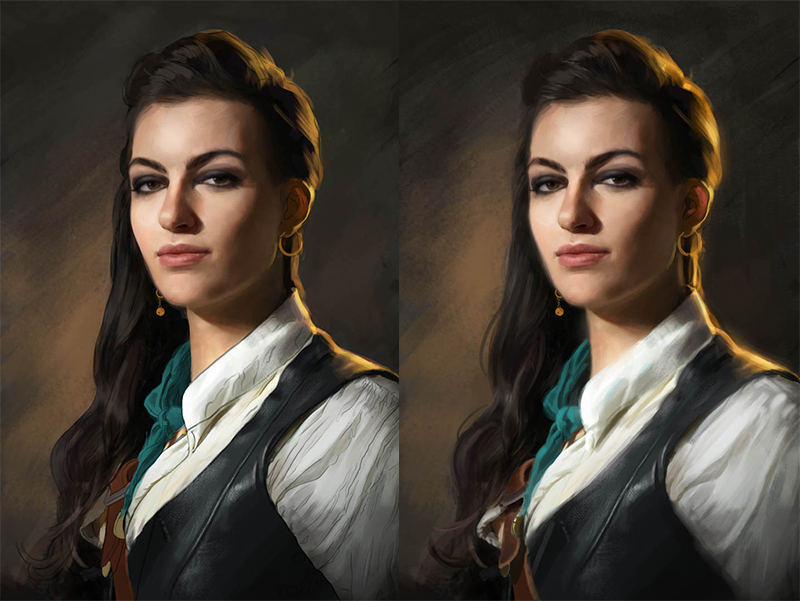
I take my fourth dimension rendering the hair, leather, wearing apparel, and pare. Refining the details takes the largest amount of fourth dimension in my painting process. Yous can also see that I as well erased some of my lines to go far look more painterly (after all, line fine art is just a base to work from.) While rendering, I thought my image looked a little flat and could utilise some punch, color, and vibrancy. Later much thought, I decided to add a pilus lite to brand the figure stand out more against the background. A "hair light" is a calorie-free behind the subject that illuminates the hair and the top of the shoulders in photography. It's also chosen a "rim light" and is used to make the effigy stand out more from the background. I chose a warm orange light to add interest and vibrancy to the painting. When using rim lights, make sure that you don't just pigment a thin line effectually your discipline, but arrive bleed into the form to bring out the iii-dimensionality.
4. Final Touches
Now that the painting is nearly done, allow's talk about the final steps that I always practice in order to bring the painting together. Due to my selection at the beginning of my painting process, I cease up with some very abrupt edges. Sharp vs. soft is i of the major means to create focal points in a painting, and so I want to make certain that I don't accidentally describe focus where I don't want it. For case, the left cheek is razor-sharp and tin can be softened a chip. Where values are shut together, I tin can soften the edges as well. For example, where her leather vest bleeds into the groundwork and where her white shirt almost merges with her neck were softened. I also softened the edges shut to the edges of the painting where I don't want to describe focus.
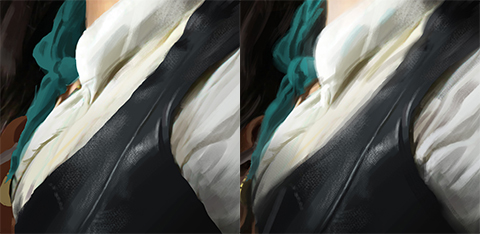
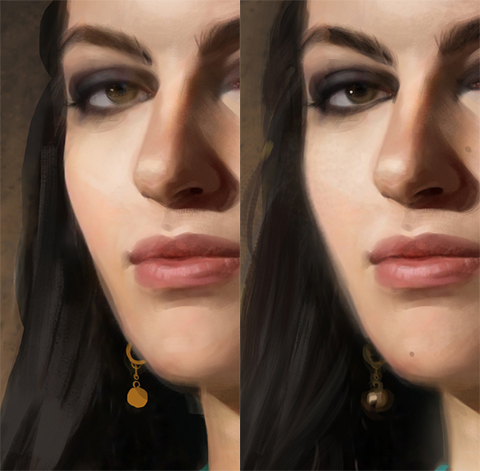
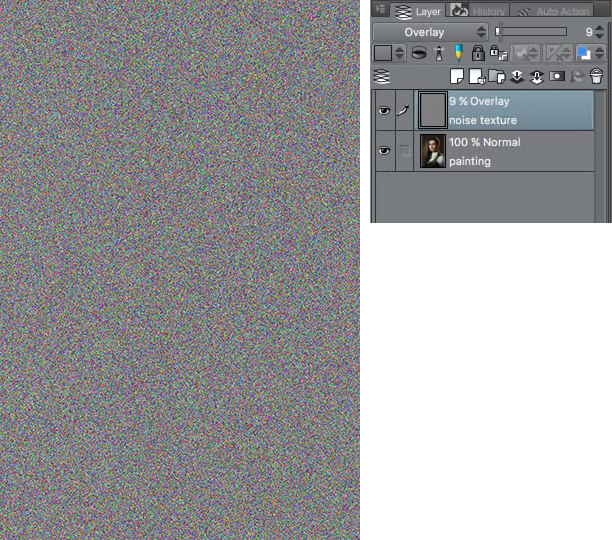
To avoid the clean, digital expect, I like to put a noise layer on peak of everything and put it on overlay at 9% transparency. This creates some visual noise that's reminiscent of a photo.
Then I allow the painting rest for a 24-hour interval, add some small details and phone call it washed.
Luisa Preissler
luisapreissler.artstation.com
Source: https://www.clipstudio.net/how-to-draw/archives/158015
0 Response to "How to Make Stylized Backgrounds for Portraits Digital Art"
Postar um comentário