Just Noticed Fluid Filled Lump on Baby's Head
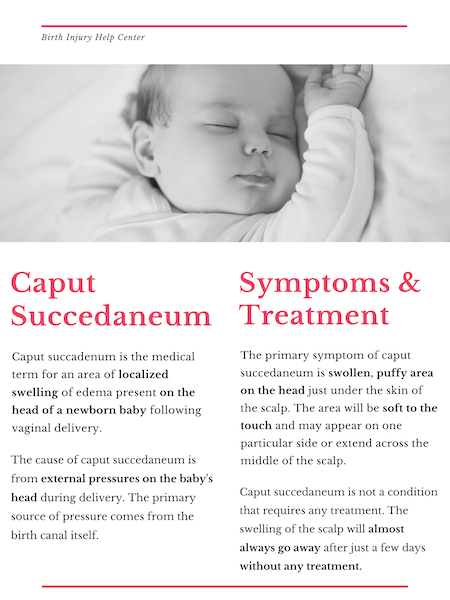
Caput succedaneum is the formal medical term for the area of localized swelling or edema which is ordinarily present on the head of a newborn infant following vaginal delivery. More simply, information technology is fluid under the skin on the baby'south caput.
Caput succedaneum is a very common and usually beneficial neonatal condition resulting from normal pressure and compression on the baby'due south head as information technology passes through the nascence canal. Head succedaneum itself is harmless as the swelling is limited to the scalp and is not a symptom of a deeper injury to the skull or brain. Although caput succedaneum itself is aught to worry about and chop-chop resolves, it tin can lead to other complications including newborn jaundice.
Causes of Head Succedaneum
The swelling in the head and scalp that characterizes caput succedaneum is the event of acute external pressures on the baby's head during labor and delivery. The primary source of this external pressure comes from the nascence canal itself. In a normal vaginal delivery, the baby is pushed through the nascence culvert headfirst.
Head-first commitment makes the elevation of the head the focal point of significant pressure as the fetus pushes its way through the very narrow nascency culvert. The most common cause is pressure on the caput from the mother'south uterus or vaginal wall during childbirth. Babies can also suffer caput during a C-section, although the force per unit area on the babe's head could still stalk from pressure on the head before the procedure.
These pressures are greater for babies that are macrosomic (high nascency-weight) or after a prolonged, difficult nascency. Total-term newborns or overdue newborns counterbalance more and are more at risk than preterm newborns. Swelling in the scalp can also exist caused by the premature rupture of the membranes that environs the infant in the womb.
After the fetal membranes rupture, the amniotic sac is no longer bachelor to act as a supportive cushion for the baby'southward caput. With little amniotic fluid, the fetus' head is subject to greater force per unit area from the mother's pelvic bones. Caput succedaneum can also be triggered by the use of a vacuum extractor or forceps to facilitate vaginal commitment.
Symptoms of Caput Succedaneum
The primary symptom of caput succedaneum is a swollen, puffy, soft spot on the meridian of the head just under the skin of the scalp. The area may appear on 1 item side or extend beyond the middle of the scalp. The bloated spot typically appears on the part of the head that went outset through the birth canal.
Distinguishing the symptoms of caput succedaneum from other more serious medical conditions with similar physical symptoms is important. Potentially dangerous conditions such as hydrocephalus also issue in swelling in the head, but usually in a different area.
The baby's md should easily be able to differentiate betwixt the symptoms of caput succedaneum and other more than serious conditions like a brain bleed or skull fracture with a elementary physical exam. Head succedaneum is easily confused with infant cephalohematoma. The former is swelling that occurs under the skin and the latter is swelling that occurs within the skin, but both are usually harmless.
Treatment of Caput Succedaneum
With head succedaneum, the baby's appearance can be alarming. However, head succedaneum is not a medical emergency nor is information technology commonly a condition that requires whatsoever treatment. The baby will almost always make a complete recovery after just a few days without whatever treatment or direction. Attempting to bleed the fluid causing the swelling tin cause infections so it is by and large a "go along an centre on and go out well enough alone" condition.
Potential Complications From Caput Succedaneum
 In the vast majority of cases, caput succedaneum goes abroad on its own with whatsoever additional complications or long-term implications. Simply there are complications that in rare cases can be significant which is why you keep an eye on it. These complications include bruising of the skin over the swollen area with necrosis. The result can be scarring and alopecia, and, in rare cases, systemic infection.
This bruising tin can cause an increase in bilirubin levels in the blood. Excess bilirubin levels are the underlying cause of newborn jaundice, a common condition. This means that head succedaneum can potentially atomic number 82 to infant jaundice or get in worse.
When properly managed and treated (usually with exposure to sunlight) babe jaundice is not a serious condition. Notwithstanding, if it is not monitored and treated, some cases can worsen and somewhen lead to a very serious and potentially life-threatening condition chosen kernicterus. Kernicterus occurs when backlog bilirubin in the blood begins to invade and damage the encephalon resulting in serious and permanent brain harm.
Caput Succedaneum as Evidence of Birth Trauma
Even though it can potentially atomic number 82 to complications like jaundice, caput succedaneum itself is not a serious business organisation. The real significance of caput succedaneum is that it is often ane of the first, most notable indicators that the baby went through a particularly difficult and stressful commitment. If a baby is born with a head succedaneum, it means that their head was subjected to meaning external pressure during delivery.
This could mean that the babe suffered a more than serious brain injury as a result of the oxygen impecuniousness during the difficult delivery. Medical professionals treating a baby with caput succedaneum should appropriately be particularly attentive to the symptoms of infant brain injury.
What Is the Difference Between Cephalohematoma and Head Succedaneum?
Infant cephalohematoma and caput succedaneum have similar causes, most notably the utilize of forceps or a vacuum, a difficult delivery, or anything that puts pressure on the infant's caput. The departure between the two comes down to location and type of bleeding.
Cephalohematoma is when blood is collected between the periosteum of the skull bone and the skull bone itself, so information technology does not cross suture lines. Caput succedaneum involves diffuse swelling of the scalp, with subcutaneous fluid collection unrelated to the periosteum with poorly defined margins. This is about often caused by pressure level on the scalp against the dilating cervix during delivery.
Additionally, head succedaneum is a highly mutual nativity injury while cephalohematomas are rarer. The chances of a caput succedaneum are relatively high, fifty-fifty in a normal newborn.
Medical Literature
- Levin, G, et, al: Risk factors associated with subgaleal hemorrhage in neonates exposed to vacuum extraction. Acta Obstet Gynecol Scand 2019; 98(xi):1464-1472. This kind of encephalon bleed presents as a compressible mass that crosses suture lines.
- Hassan, W.A., et. al: Intrapartum assessment of head succedaneum past transperineal ultrasound: a 2-center pilot written report. ([In press])Aust Due north Z J Obstet Gynaecol. 2015. Study discusses how caput succedaneum can also be expressed equally ultrasound measured skin-skull distance.
- Schwimer, S. R., Lebovic, J. (1986). In utero sonographic demonstration of a caput succedaneum. Journal of Ultrasound in Medicine, 5, 711-712.
- Lapeer RJ, Prager RW (2001)Fetal head moulding: finite clement analysis of a fetal skull subjected to uterine pressures during the get-go stage of labor. J Biomech, 1125-33.
- LeBlanc, C, et. al (1995). Cephalohematomas revisited: When should a diagnostic tap be performed? Clinical Pediatrics, 34, 86-89
- Petrikovsky, B., et. al (1998). Cephalohematoma and caput succedaneum: Do they always occur in labor? American Journal of Obstetrics and Gynecology, 179, 906-908. Word of the clan of head and premature rupture of membranes.
- O'Brien WF, et. al (1984). Effect of cephalic pressure level on fetal cerebral claret menses. Am J Perinatol 1984; ane(3):223-6. v
FAQs: Head Succedaneum
Below are easy-to-understand answers to some very mutual questions and concerns relating to caput succedaneum in newborns. Some of this is addressed above but some parents prefer to get their information in a question and answer blazon format.
What is caput succedaneum?
Caput succedaneum is an expanse of swelling nether a newborn infant's scalp because of some external trauma to that area of the head during vaginal childbirth. Information technology is usually harmless and does not last long, typically a month or and so.
Is caput succedaneum serious?
Caput is non considered a serious injury and the swelling generally does non concluding long, usually goes away on its own within a month without whatsoever treatment. Notwithstanding, caput succedaneum is a potential indicator that the baby underwent a difficult or stressful nativity and could take other more serious internal injuries as a issue.
What causes caput succedaneum?
Again, caput succedaneum is acquired by external pressure or force on the baby'south head during delivery which ruptures small blood vessels beneath the scalp. This pressure can merely be caused by passing through the birth canal or the result of delivery assistance tools such as vacuum extractors or forceps.
Source: https://www.birthinjuryhelpcenter.org/caput-succedaneum.html
0 Response to "Just Noticed Fluid Filled Lump on Baby's Head"
Postar um comentário